

Film Critic: Stephen ‘Spling’ Aspeling
John van de Ruit’s character, John “Spud” Milton, has become the South African equivalent of Sue Townsend’s Adrian Mole. Both characters are at that awkward age when puberty is starting to kick in, physical changes inevitably cause clumsy embarrassment, and adult life is only just beginning. These are the formative years, yet we experience a burst of nostalgia by suffering through their identity crises and painful pubescent moments, deeply connecting with where they are coming from. It’s no wonder their experiences are so enchanting, memorable and uplifting.
Van de Ruit’s Spud series has captivated the South African market much like Adrian Mole did in the ’80s and ’90s for younger readers and adults alike. While one functions as a novel-based diary and the other a direct journal, it’s the shared day-to-day growing pains that make the journey so unique – tapping into the vulnerability of human nature and the classic triumph over adversity. Above all, it is a great read; who doesn’t root for the little guy, and who hasn’t felt like a “Spud” in one situation or another?
Spud has entrenched itself as a firm favourite for ex-boarders, fascinated schoolboys living similar lives and curious outsiders. The book has now made the leap from van de Ruit’s best-selling pages to the silver screen, and for the most part, it’s a resounding success. The film adaptation stays faithful to the novel, capturing 1990s South Africa around the release of Nelson Mandela as Spud begins his first year at Michaelhouse, an elite boys’ boarding school in the KwaZulu-Natal Midlands.
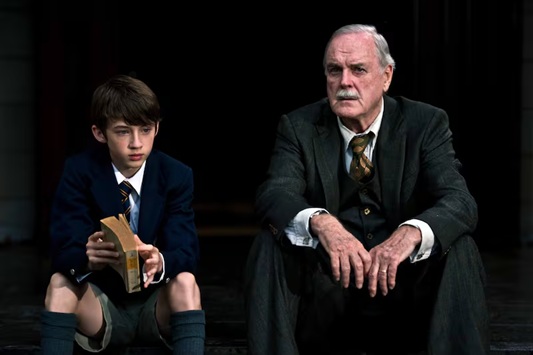
The casting of the film’s principal co-stars, a young Troye Sivan and comedy icon John Cleese, raises the production to an international standard. Cleese’s involvement brings significant cross-border appeal – marking one of his most prominent live-action roles in years – while Sivan takes on his first leading feature role. Sivan (X-Men Origins: Wolverine) projects intelligence, humility, charm and a brimming talent reminiscent of Freddie Highmore. Both young actors share a gentle screen presence anchored by a compelling sense of innocence.
John Cleese delivers a passionate performance as “the Guv,” embracing the character with genuine warmth. He showcases his veteran comedic instincts while fully leaning into the dramatic beats of his tragic, alcoholic character. Cleese provides both the narrative backbone and dramatic credibility, while generously leaving space for Sivan to shine. His English teacher character naturally invites comparisons to Robin Williams in Dead Poets Society, reinforced by direct references to Dickens’ Oliver!. Ultimately, Cleese brings a fighting spirit and fatherly warmth to the role, focusing heavily on the duo’s evolving friendship.
Strong supporting performances are delivered by Aaron McIlroy as Spud’s wonderfully unhinged father, Jason Cope as the Crazy 8s’ housemaster, “Sparerib,” and Jamie Royal as young “Gecko.” The ensemble features top South African talent – including Jeremy Crutchley, Julie Summers and Graham Weir – even if their screen time is limited. Meanwhile, Tanit Phoenix leads the eye-candy contingent as the alluring Eve, alongside Genna Blair as “Mermaid,” Charlbi Dean Kriek as the manipulative Amanda, and Alex McGregor as Christine.
Director Donovan Marsh treats the schoolyard antics as a comedy with a grounded undertone. While late-night swims and shouting from dormitory windows offer a Peter Pan vision of boarding school, darker elements of initiation and hard-earned respect also filter through. Bare-bum shoe polish scrubs and toilet dunks on your birthday may not serve as the best advertisement for prospective parents, but their inclusion keeps the adaptation faithful. ‘The Lord of the Flies’ group mentality inevitably kicks in – a rough rite of passage on the road to becoming one of the boys.
Speaking from experience, the good times are the most memorable, which is why recounted boarding school memories so often lean into comedy. The tougher moments, however, build character, mental resilience, independence and stamina – traits far harder to forge at home. Boarding school crafts lifelong friendships, turning classmates into brothers.
Marsh directs Spud with clear affection for films like Dead Poets Society. However, there is a distinct theatrical quality here, amplified by the staging of Oliver!, creating a play-within-a-film dynamic that highlights the teacher-student relationship. While Spud favours comedy over heavy drama, it relies on situational humour rather than purely sharp dialogue to drive its laughs. Cleese delivers several classic lines with precision, but the overall tone remains rooted in high-spirited, coming-of-age fun.
As the movie progresses, intermittent laughs gradually give way to more touching, grounded moments. Spud is thoroughly entertaining, delivering continuous value through standout lead performances and a committed supporting cast. The film’s dramatic structure almost warrants reverse engineering into a stage play – its theatrical energy could easily mirror the crossover success of a production like The History Boys. Much like its title character, Spud rises to the challenge, ready to silence its naysayers and welcome an eager audience along for the ride.
For more film reviews, visit SPL!NG.